
A demand meter records how much power demand a business generated during either a 15- or 30-minute time window (Demand Interval) and stores the maximum value in the electricity distributor’s register. The distributor then calculates the power demand based on the average power used during that demand interval and includes the demand charge in the utility bill.
Demand charges can be a significant part of a small business utility bill. The more electricity used at one time, the higher the demand is, and the harder the grid must work to provide a business site with sufficient power.
The demand meter at a small business site might look very much like the meter at homes, which also records the total electricity consumption in a billing month. The demand meter measures both the total monthly consumption of electricity used (kilowatt-hours) and the peak of power (measured in kilowatts or kilovolt-amperes) a business needed at any given point during the month.
How to read the demand meter
A power demand meter will cycle through various displays every three to five seconds. The two most important display modes are:
- Usage
- Peak demand
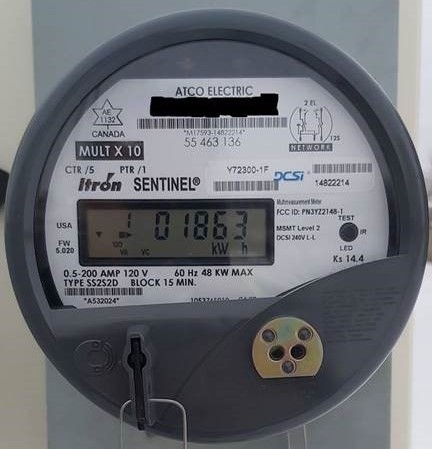
The usage mode shows how many total kilowatt-hours a business has consumed since the meter has been installed. Consumers can find out how much power they have used since the last bill reading by subtracting the total monthly consumption on the electricity bill from the kilowatt-hour usage seen on your meter screen.
In this example, the demand meter screen indicates the consumption of 1,863 kWh.
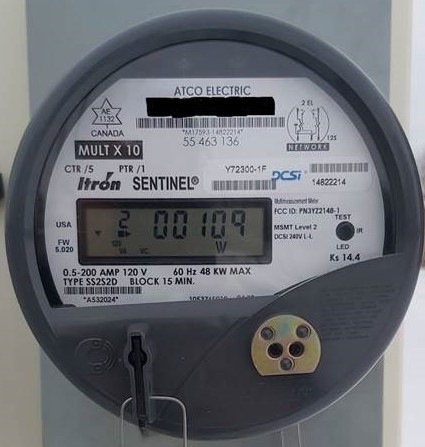
The Peak Demand mode represents the highest 15 or 30 minutes of power used since the last 30-day billing period. Peak Demand helps electricity distributors determine the size of equipment needed to supply energy to a business. Once a demand peak is reached, the demand charges will be based on that peak for the next twelve months, even if a business does not reach that peak again. The 12 months will reset whenever a new peak is hit. The numbers in the example below indicate the maximum power load of 109 watts (0.109 kW) at some time since the last billing.
Some companies use kilovolt-amperes to measure peak demand, as in this example indicating the power load of 0.614 kVA.

How demand meters operate
To understand how a demand meter operates, think about how a car's odometer and speedometer work to measure distance and speed.
- Similar to how an odometer records every kilometer your car travels, the demand meter records every kilowatt-hour of your electricity consumption.
- Demand is like measuring a cars speed. As accelerator is pushed, the car goes faster, and the speedometer shows higher readings. When a car slows down, the values on the speedometer decrease. The electricity demand value goes up and down to match how much electricity a business needs at any given moment.
- Similarly, when a car stops and the speedometer moves back to zero, the demand value also resets back to zero when a new billing period starts.
- Unlike a speedometer, a demand meter records the highest average demand reached and maintained in a demand interval within the billing period.
For example, if your demand reaches 5 kW and stays there for a demand interval of 15 minutes, the stored registered value remains at 5 kW unless or until your demand exceeds that level. If your demand later reaches 6 kW and stays there for 15 minutes, a new index point will be established.